
It’s no secret that relying on a single cloud provider can easily lead to dreaded vendor lock-in, allowing the provider to raise costs and limit access to a broader range of cloud services. Future-proofing your automation tooling with a multi-cloud design can help you stay ready to deploy and maintain infrastructure with any provider. As our clients continue to embrace multi-cloud solutions, Samtek has been overhauling our cloud automation tooling to support a multi-cloud design. Along the way, we’ve gathered valuable lessons that can help other organizations transition their automation tools to a multi-cloud environment. Here are three ways to build multi-cloud automation that lasts.
1. Start with Modular Design
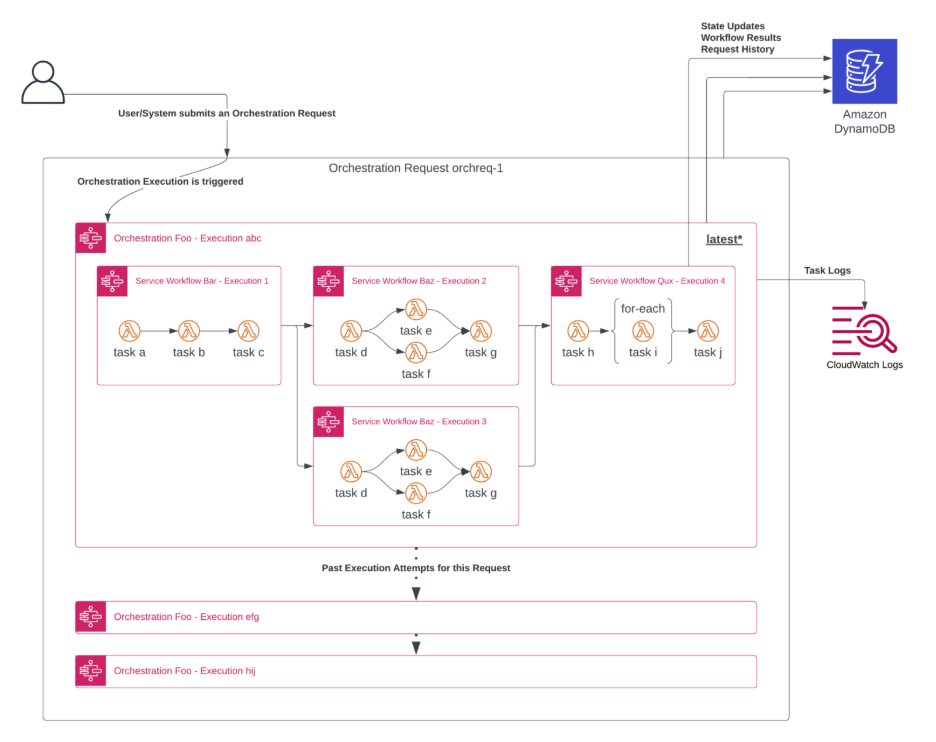
Designing cloud automation tooling to be modular from the start can make it adaptable for a multi-cloud strategy. This approach lets us break our automation into modular steps, enabling code reuse across multiple cloud services. To do this, we split our automation processes into two types of workflows: orchestrations and service workflows.
- Orchestrations are high-level workflows that chain together multiple service workflows to achieve a final objective.
- Service workflows perform common tasks for a given service and can be reused by multiple orchestrations across different cloud providers.
By separating orchestrations from service workflows, you can swap out cloud-specific steps while keeping the overall process intact. Designing your automation with modularity in mind from the beginning makes it much more adaptable for a multi-cloud environment.
2. Choose Cloud Agnostic over Cloud Native
Shedding cloud native tools in favor of cloud agnostic solutions helps you avoid vendor lock-in and build a more versatile multi-cloud solution. Cloud native tools can be tempting for their integrations and easy setup, but once you commit to them, it can be difficult to translate your automation to competing cloud services.
Take Infrastructure as Code (IaC) as an example. If you start by supporting only AWS, you might rely on its native IaC tool, CloudFormation. But when you’re later asked to automate deployments for Azure or GCP, you may find yourself starting from scratch. That’s why a cloud agnostic IaC tool like Terraform can be a wiser choice—you avoid rework, saving both time and money.
It’s worth reviewing your cloud native tooling to see if it’s a productive part of your automation or if it contributes to vendor lock-in In many cases, there’s a cloud agnostic tool that can accomplish the same thing while being portable across multiple cloud providers.
3. Keep your Automation in One Place
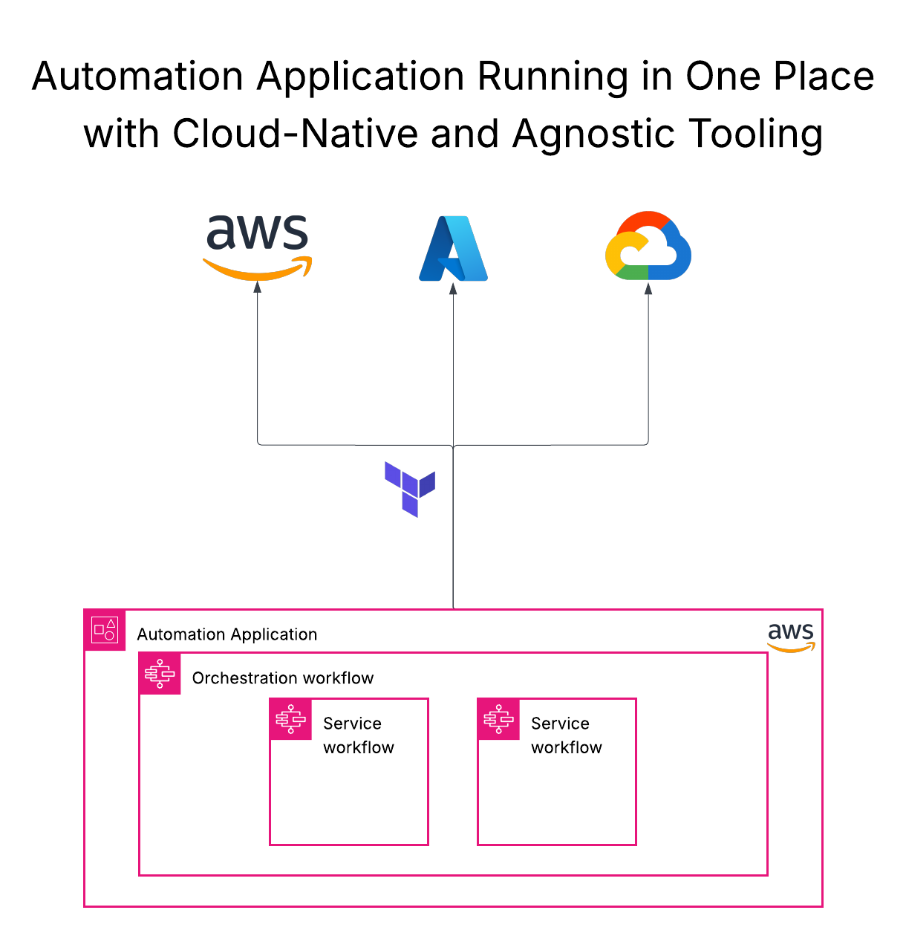
Even though your automation may provision, decommission, and maintain cloud infrastructure across multiple providers, it’s still a good practice to keep automation centralized on one cloud platform, interacting with multiple cloud providers programmatically. Keeping your automation in one place consolidates monitoring and alerting. When you have one place to set alerts, diagnose issues, and see your deployments, your team can work faster and make fewer mistakes. It also allows code-driven deployments. If you keep your deployments as IaC and API calls to your various cloud providers, you benefit from version control, eliminate manual errors, and put security and compliance as part of your CI/CD, catching vulnerabilities before deployment.
And, finally, you can take advantage of native tooling. Because the automation interacts with cloud providers via code, you can keep your automation application running in one place, taking advantage of your preferred cloud provider’s tooling. For example, we rely on AWS step functions for our automation workflows, while keeping the deployments or interacting with other services within Lambda functions. This way, you can get the best of one provider’s tooling while still staying cloud agnostic in your automation workflows.
Future-proofing automation takes work, but it doesn’t have to mean starting over every time your cloud strategy evolves. By designing modular workflows, favoring cloud agnostic tools and centralizing automation in a single control point, you can build a foundation that can adapt as providers, services, and requirements change. At Samtek, this approach has helped us move faster while staying flexible. It can do the same for your organization. Want to learn more about how Samtek’s IT solutions can transform your organization? Reach out and start the conversation.