

Overview
Adopting cloud technology at government agencies is a complex project with the potential to impact almost every aspect of an organization. Fully enjoying its benefits requires a complete cultural transformation. There are many different approaches to adopting cloud technology. At Samtek, we focus on:
- Understanding the business case
- Defining cloud vision and model
- Building security, cost, and automation-first cloud strategy
- Establishing governance
- Incorporating cloud mindset in agency culture
When problems arise during a cloud transformation effort, they can often be traced back to organizational culture. That’s why we believe establishing culture and mindset is the first step for any successful cloud transformation. We’re cloud-fluent and have a proven record of adapting, surviving, and thriving with the absorption of new technologies. We’ve helped teams align their cloud strategy with their IT and business strategies. We want to encourage you to start thinking about the cloud first and incorporating cloud strategy into your overall business plan.
Principles of Cloud Journey
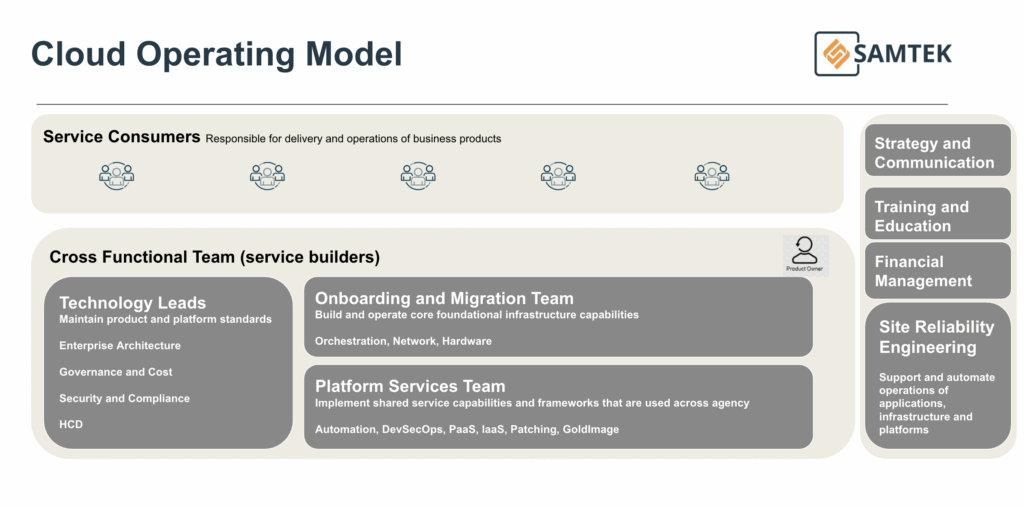
For successful cloud transformation, the team needs to redesign the operating model to ensure the right team structure and capabilities are in place. It’s also important to have a cross-functional team to make sure individual teams are compliant with established cloud practices and adhere to these key principles:
- Define and enforce reference architecture
- Build right kind of team
- Scope the teams’ responsibilities
- Empower teams to teach and uphold best practices
- Help ensure central oversight to mitigate issues
- Enable self-servicing while keeping costs under control
Cross-Functional Team
The cross-functional team is made up of several multidisciplinary teams that combine infrastructure and application development expertise. These teams align around a cohesive product roadmap approved by the product manager or owner.
Cloud Fluency at Scale
To achieve cloud fluency at scale, we help teams develop and follow a culture-change roadmap to ensure that introducing cloud fosters an end-to-end transformation across all dimensions of your business.
Processes
Below are several processes we use to make sure that everyone stays focused and collaborates throughout the entire cloud adoption process.
DevOps & Agile
Agile prioritizes iterative change and cross-functional collaboration and enables teams to respond quickly.
DevOps defines a culture where development and operational teams are embedded to own all aspects of a service, to deliver software faster and more reliably.
Adopting these processes and bringing teams out of siloes to work collaboratively are essential components of the Cloud Operating Model.
Roadmap
A roadmap documenting cloud transition strategy and goals are key for the success of cloud adoption. And, the roadmap needs to include every step, action, and deliverable along the cloud adoption journey.
30/60/90 Day Plan
Building a cloud strategy to help move forward in the next 30, 60, and 90 days can help map out goals, track progress, and prioritize tasks.
Non-Functional Requirements (NFRs)
Consider non-functional requirements like availability, scalability, performance, adaptability, security, and maintainability before moving workloads to the cloud. It’s also important to understand your cloud provider’s capabilities and have proper architecture to help deliver NFRs successfully.
Conclusion
Fostering a cloud culture in your organization is the most important step in successful cloud adoption. A collaborative and focused team following a roadmap will stay fast, reliable, and compliant, and will facilitate the successful transformation of your business.